Kaitlin Moore
22-year-old from Western Australia
Strategic Communication student at Murdoch University
Working towards a career in sports media and PR

Below is the portfolio of work that I have produced during my time at university for both hypothetical and real-life clients. Please click on the images to learn more or on the contact links at the bottom of the page for more information :)
Press Releases, Speeches and Media Relations



Research and Analysis



Strategic Communication Campaign Plans



This is an Issue Analysis Research Plan developed for COM345: Issues and Crisis Management. I chose to examine the affect that the Russian invasion of Ukraine had on the International Tennis Federation.
Background of the Client
The International Tennis Federation (ITF) has been the governing body for tennis around the world since its foundation in 1913. In collaboration with the Association of Tennis Professionals (ATP) and the Women’s Tennis Association (WTA), the ITF oversees all levels of professional tennis worldwide and adjudicates player rankings. Further responsibilities of the ITF include imposing the rules of tennis, overseeing international team competitions, maintaining the integrity of the sport (primarily through anti-doping and anti-corruption investigations), and promoting the game around the world through education and development programs.In 2016 the ITF announced their new long-term plan, titled ITF2024, which highlighted eight priorities (ITF2024 Strategy 2016):
⠀⠀⠀⠀1. Opportunity: providing opportunities to players at every level of the game
⠀⠀⠀⠀2. Development: offering players the right kind of support in order for them to develop their skills
⠀⠀⠀⠀3. Davis Cup and Billie Jean King Cup: continuing to support the ‘flagship’ international team competitions
⠀⠀⠀⠀4. Olympics and Paralympics: continue to elevate the position of tennis at the Games and in order to maintain its position as a stand-out event
⠀⠀⠀⠀5. Integrity: hold everyone involved in the sport to a high standard
⠀⠀⠀⠀6. Investment: responsibly and strategically reinvest earned revenue back into tennis development worldwide
⠀⠀⠀⠀7. Partnerships: strengthen the position of tennis around the world through important and relevant partnerships
⠀⠀⠀⠀8. Communications: engage with member nations and other relevant stakeholdersIn terms of media and communication, the ITF engages with stakeholders and fans through an e-mail newsletter, press releases and features regularly posted on their website, and at in-person events. They also operate a number of successful social media channels, primarily Instagram (222 thousand followers), Twitter (52,000 followers), and Facebook (572,000 likes).Overview of the Issue
On the 24th of February 2022 Russia, with the support of Belarus, launched an invasion of Ukraine. This came after months of mounting tension as Vladimir Putin’s army began to build up its presence along the northern border of Ukraine. In a televised broadcast prior to the invasion, Putin questioned Ukraine’s right to statehood and said that the eastern expansion of the North Atlantic Treaty Organisation (NATO) posed a threat to Russia’s security – though this has been refuted by NATO (2022).Since the invasion began, over 4.5 million people, mostly women and children, have fled Ukraine, creating Europe’s largest refugee crisis since World War II (United Nations Human Rights Council 2022). There have also been reports of mass human rights violations as well as war crimes and crimes against humanity committed by the Russian military, who committed “indiscriminate attacks on civilian areas and strikes on protected objects such as hospitals” (Amnesty International 2022).The invasion and its resulting human rights violations have been widely condemned by global institutions such as the United Nations General Assembly and the International Court of Justice, with the former voting to suspend Russia from its Human Rights Council (Nichols 2022). A large number of countries and organisations have imposed or expanded upon harsh sanctions against Russia and Belarus in retaliation, triggering an international boycott of these countries.On the 25th of February, the International Olympic Committee called on international sporting bodies to “do everything in their power to ensure that no athlete or sports official from Russia or Belarus be allowed to take part under the name of Russia or Belarus. Russian or Belarusian nationals, be it as individuals or teams, should be accepted only as neutral athletes or neutral teams. No national symbols, colours, flags or anthems should be displayed” (Boren 2022). A number of sporting bodies, such as those for athletics, baseball, and figure skating, have outright banned athletes from Russia and Belarus, whilst some are able to compete under a neutral flag in other sports such as swimming, cycling and motor racing. A number of sporting events set to be held in Russia have been cancelled or relocated, such as the Formula One Russian Grand Prix set to be held in Sochi and the Union of European Football Associations Champions League final (The Associated Press 2022).On the 1st of March 2022, the ITF released the following statement: “The ITF condemns Russia’s invasion of Ukraine and its facilitation by Belarus. In addition to the cancellation of all ITF events in those countries, the ITF Board has today announced the immediate suspension of the Russian Tennis Federation (RTF) and Belarus Tennis Federation (BTF) from ITF membership and from participation in ITF international team competition until further notice. The ITF remains in close contact with the Ukraine Tennis Federation and stands in solidarity with the people of Ukraine.” (ITF 2022).Key Stakeholders
- the International Tennis Federation (ITF)
⠀⠀⠀⠀- Key People: David Haggerty (President), Kelly Fairweather (Chief Executive Officer), Heather Bowler (Senior Executive Director, Communications), Kris Dent (Senior Executive Director, Major Events and Strategy), Alexey Selivanenko (Board Member – Russia), and other personnel within these departments- the Association of Tennis Professionals (ATP)
⠀⠀⠀⠀- The ATP is the governing body of mens professional tennis circuit and protects the interests of male professional tennis players
⠀⠀⠀⠀- Key People: Massimo Calvelli (Chief Executive Officer), Simon Higson (Executive Vice President, Communications), and other personnel within these departments- the Women’s Tennis Association (WTA)
⠀⠀⠀⠀- Similar to the ATP, the WTA is the organising body for women’s professional tennis and works to promote female players
⠀⠀⠀⠀- Key People: Steve Simon (Chief Executive Officer), Amy Binder (Vice President, Global Communications), Ashley Keber (Vice President, Member Relations), and other personnel within these departments- The Russian Tennis Federation (RTF)
⠀⠀⠀⠀ - The RTF is the national governing body of tennis in Russia but has had its affiliation with the ITF revoked
⠀⠀⠀⠀- Key People: Shamil Tarpishchev (President)
⠀⠀⠀⠀- Prominent Players: Danill Medvedev (Current World No. 2), Andrey Rublev, Anastasia Pavlyuchenkova, Aslan Karatsev, Daria Kasatkina, and Ekaterina Alexandrova- The Belarus Tennis Federation (BTF)
⠀⠀⠀⠀- Similar to the RTF, the BTF is no longer affiliated with the ITF
⠀⠀⠀⠀- Key People: Rutenko Sergey Alekseevich (Chairman)
⠀⠀⠀⠀- Prominent Players: Ivashko Ilya Vladimirovich and Sobolenko Arina Sergeevna- Ukraine Tennis Federation (UTF)
⠀⠀⠀⠀- Key People: Sergiy Lagur (President) and Evgeniy Zukin (Managing Director)
⠀⠀⠀⠀- Prominent Players: Elina Svitolina, Anhelina Kalinina, and Marta Kostyuk- the International Olympic Committee
⠀⠀⠀⠀- Key People: Thomas Bach (President), Anant Singh (Chair, Communications Commission), Emma Terho (Chair, Athlete’s Commission), Ki-Moon Ban (Chair, Ethics Commission), Luis Moreno (Chair, Commission for Public Affairs and Social Development through Sport), and other personnel within these departments- Sponsors
⠀⠀⠀⠀- Key sponsors of the ITF, ATP and WTA include Emirates, Dunlop, Porsche, Uniqlo, and Microsoft
⠀⠀⠀⠀- Players are also supported individually by sponsors, for example Daniil Medvedev is sponsored by Lacoste, BMW, Technifibre, and Tinkoff, whilst Elina Svitolina is sponsored by Nike, Wilson, and Hublot- Tennis Community
⠀⠀⠀⠀- In 2019 ITF President David Haggarty said that there was a community of over 87 million tennis players coming from 195 different countries, making it one of the most-played sports worldwide (ITF 2019).
⠀⠀⠀⠀- Furthermore, worldwide viewership of tennis is increasing, with Eurosport finding that growth in digital viewership of Grand Slam competitions was up 20% in 2019 (Stammers 2019)- Media
⠀⠀⠀⠀- Print, digital, and social media outlets that report on global sporting or political issues
⠀⠀⠀⠀- Tennis and sports-centric publications and platforms such as Tennis.com, ESPN, Fox Sports, Tennis Industry News, and Tennis WorldAnalysis
The issue of whether Russian and Belarusian athletes should be allowed to compete in international competitions has undoubtedly had an effect on the ITF, especially due to the prominence of Russian players such as Medvedev. The issue had also undoubtedly brought more media and public attention to sporting governing bodies such as the ITF, as calls for boycotts and sanctions began to increase after the initial invasion. Therefore, the ITF acted swiftly in announcing that all events planned to be held in Russia and Belarus would be cancelled indefinitely and that both the RTF and the BTF would have their memberships suspended and be barred from international team competition. However, they stopped short of banning Russian and Belarusian players altogether, instead allowing them to compete individually under a neutral name and flag.Another aspect of this issue is of possible discrimination against Russian athletes. The situation is complicated, in that the athletes themselves are not responsible for the actions of their government and have undoubtedly worked extremely hard to reach their current positions. However, it is important to remember that the Russian government is known to exercise its soft power through ‘sports washing’: since rising to power Putin has used the hosting of high-profile sporting events such as the 2014 Winter Olympics held in Sochi to “present Russia as a reliable, professional international partner” (Siccardi 2022).Furthermore, the decision to allow Russian and Belarusian athletes to compete may cause further issues for the ITF down the line. For example, when asked recently about allowing Russian athletes to compete at Wimbledon, the United Kingdom’s Minister for Sport Nigel Huddelston stated: “We need some potential assurance that they are not supporters of Vladimir Putin. We’re considering what requirements we may need … Many countries around the world have agreed that we will not allow representatives from Russia to compete and there are visa implications here as well” (Matthey 2022). This contradicts the ITF’s initial statement that athletes would be able to compete under a neutral flag, which has the potential to cause a new issue to arise between the ITF and other nations where they intend to hold events, as these countries would have the ability to stop Russian athletes from obtaining a visa. It is also important to consider the long-term effects of this issue on the ITF, especially once public interest and pressure begin to fade.Methodology
⠀⠀⠀⠀1. Assess
It is important that the ITF continues to assess the ongoing situation in Ukraine by utilising applications such as Google Alerts. Furthermore, as this is an ongoing issue, it is essential that research and evaluation be conducted at every point.
⠀⠀⠀⠀2. Monitor
Continue monitoring public opinion on the issue (through various means such as social media monitoring and news analysis) and observe the actions of other international sporting bodies. In a situation such as this, the ITF would benefit from adhering to recommendations made by organisations such as the IOC, which can be achieved through inter-organisational communication.
⠀⠀⠀⠀3. Create
Develop and launch a strategic communication campaign with a number of aims, such as:
⠀⠀⠀⠀⠀⠀⠀⠀a. Support and promote the Ukrainian Tennis Federation and uplift the voices of Ukrainian tennis players, and
⠀⠀⠀⠀⠀⠀⠀⠀b. Answer any questions that have arisen regarding the participation of Russian and Belarusian athletes that have not yet been clarified (regarding neutral flags, the playing of national anthems, etc.).
⠀⠀⠀⠀4. Looking forward
As some nations are considering barring Russian and Belarusian athletes from competitions, the ITF could look into providing alternatives for Russian athletes who still wish to compete. For example, the Fédération International de l’Automobile (FIA), the governing body for world motorsport, allows Russian and Belarusian competitors to take part in competitions if they sign a statement saying that they won’t publicly endorse the actions of Putin or the Russian government and military (SkySports 2022). However, it is important to make sure that the issue is not ‘swept under the rug’, and that organisations like the ITF continue to treat it as a developing and very important issue.References
Amnesty International. 2022. “Russian military commits indiscriminate attacks during the invasion of Ukraine.” February 25, 2022. https://www.amnesty.org/en/latest/news/2022/02/russian-military-commits-indiscriminate-attacks-during-the-invasion-of-ukraine/The Associated Press. 2022. “A glance at reaction of sports to Russian invasion.” March 4, 2022. https://apnews.com/article/russia-ukraine-sports-soccer-hockey-tennis-695b6402e04296a0d18dd232268c0ba0Boren, Cindy. 2022. “IOC, FIFA clamp down on Russian and Belarusian athletes and teams.” The Washington Post. February 28, 2022. https://www.washingtonpost.com/sports/2022/02/28/sports-russia-ukraine/ITF. 2019. “ITF and national associations announce world tennis number project.” July 8, 2019. https://www.itftennis.com/en/news-and-media/articles/itf-and-national-associations-announce-world-tennis-number-project/ITF. 2022. “ITF suspends Russia, Belarus from ITF membership and team competition.” March 1, 2022. https://www.itftennis.com/en/news-and-media/articles/itf-statement-itf-suspends-russia-and-belarus-from-itf-membership-and-international-team-competition/ITF2024 Strategy. 2016. “The ITF is on a journey of change.” Accessed April 9, 2022. https://www.itftennis.com/en/growing-the-game/itf-2024-strategy/Matthey, James. 2022. “Daniil Medvedev, other Russian tennis stars may be banned from Wimbledon.” Fox Sports. March 16, 2022. https://www.foxsports.com.au/tennis/wimbledon/daniil-medvedev-other-russian-tennis-stars-may-be-banned-from-wimbledon/news-story/33d4ad5eacd940031bdfb032145c45a0Nichols, Michelle. 2022. “U.N. suspends Russia from human rights body, Moscow then quits.” Reuters. April 8, 2022. https://www.reuters.com/world/un-vote-suspending-russia-human-rights-council-over-ukraine-2022-04-07/North Atlantic Treaty Organisation. 2022. “NATO-Russia relations: the facts.” Accessed April 9, 2022. https://www.nato.int/cps/en/natohq/topics_111767.htmSiccardi, Francesco. 2022. “Unprecedented Football Sanctions Strip Russia of a Key Form of Soft Power.” Carnegie Europe. March 16, 2022. https://carnegieeurope.eu/2022/03/16/unprecedented-football-sanctions-strip-russia-of-key-form-of-soft-power-pub-86651SkySports. 2022. “FIA reveals pledges Russian drivers must make to race in F1 following Ukraine invasion.” March 4, 2022. https://www.skysports.com/f1/news/12433/12557174/fia-reveals-pledges-russian-drivers-must-make-to-race-in-f1-following-ukraine-invasionStammers, Steve. 2019. “Eurosport strikes multi-market Wimbledon return.” Eurosport. December 20, 2019. https://media.eurosport.com/post/eurosport-strikes-multi-market-wimbledon-returnUnited Nations Human Rights Council. 2022. “Operational Data Portal – Ukraine Refugee Situation.” Accessed April 9, 2022. https://data2.unhcr.org/en/situations/ukraine
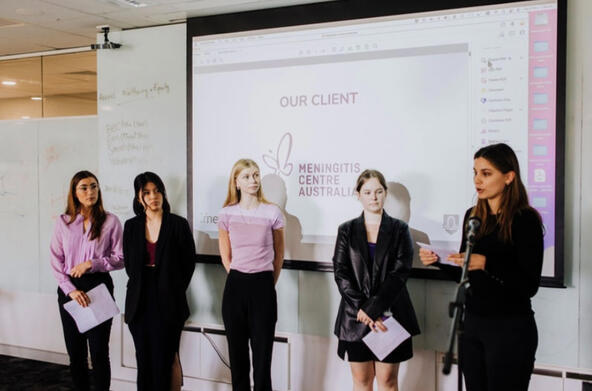
Throughout Semester 2 of 2022 I worked as a member of a consulting team to develop a strategic communication plan for Meningitis Centre Australia. My primary role was as the client liaison, group representative and administrator. My responsibilities included researching and developing the channels and tactics (I specifically worked on the competition and social media sections), configuring a budget, planning sponsorships, and presenting our project at the Luminosity event. Over the course of the project, I also assisted with developing the campaign message, goals and objectives, writing part of the evaluation, and doing final edits of the report.Overall, I had a positive experience working as a member of a consulting team, and the aspects of it that weren’t exactly positive still allowed me to take it as a learning opportunity and develop my professional skills. Despite having to face a number of obstacles, such as team members being sick or extremely busy with other commitments and myself being unavailable whilst working interstate for two weeks, we came out the other side with a strong plan that our client was very impressed by. This project was a great way to experience the ups and downs of working in a consulting team, as it was essential that we overcame these issues and worked together to deliver on our brief from MCA's CEO Karen.
Campaign Message
We chose ‘Bring Meaning To Meningitis’ (or #BMTM) as the primary campaign message as although the general public may have heard the word before, they may not have a thorough understanding of what meningitis actually is and the impact it can have. The campaign aims to educate our chosen target audience on the symptoms and consequences of the disease and emphasise the importance of how serious it is, also continuing to build on MCA’s existing #KnowActVax messaging.Goals and Objectives
Goals:
⠀⠀⠀⠀⠀⠀⠀- To raise awareness and understanding of meningitis and its symptoms with caregivers of young children and infants.
⠀⠀⠀⠀⠀⠀⠀- To encourage parents that their children are vaccinated and are up to date.
⠀⠀⠀⠀⠀⠀⠀- To implement a competition between WA schools to aid with fundraising that can also be replicated with other demographics.
⠀⠀⠀⠀⠀⠀- To grow the standing of MCA within WA whilst also expanding nationally over the next 5 years.Objectives:
⠀⠀⠀⠀⠀⠀- To involve at least 15 schools in the competition in Term 3 (2023).
⠀⠀⠀⠀⠀⠀- To host a workshop at 15 schools with an attendance of 300 kids each in Term 3 (2023).
⠀⠀⠀⠀⠀⠀- To have 100 unique website visitors by the end of Term 3 (2023) via QR code scans from distributed brochures.
⠀⠀⠀⠀⠀⠀- To expand the competition to be nationwide within the next five years (2027).
⠀⠀⠀⠀⠀⠀- To maintain relationships with three ongoing competition sponsors throughout the next five years (2027).Channels and Tactics
Social Media
Social media platforms are becoming an increasingly popular channel for health-related communication campaigns. Furthermore, using multiple channels ensures messages are amplified and target audiences are reached. The most effective platforms for healthcare campaigns are Facebook and Instagram, which MCA already has a presence on. Current content produced by MCA for Facebook and Instagram is eye-catching and well-designed, yet engagement rates remain low.Developing on the established page, it is suggested that Facebook is used to target parents/guardians and grandparents, where research suggests that audiences aged 25-35 and 55-65 predominantly use the platform. Images, video and copy will focus on topics of Meningitis awareness and vaccination, and feature imagery of young children to relate to the audience of caregivers. Posts will be text-based and emotive, with stories of those affected by Meningitis being shared; promoting storytelling.Instagram should be used to target parents and childcare workers aged around 25 to 44 years old, which is the second largest age demographic using the platform in Australia. The campaign will embrace Instagram’s increasing promotion of videos and involve the production of Reels. To balance emotive storytelling and practical information, these will showcase survivor stories, and medical professionals showing footage of the early symptoms. The video content produced for Instagram could also be repurposed for TikTok if at a later time we chose to expand our channels with the growing campaign. As it stands, we chose not to include TikTok due to the facts that MCA does not have an existing presence on the app and it is not the channel used the most by our current target audiences.Across Facebook and Instagram, the campaign will act to increase engagement through the use of interactive tools on Instagram and Facebook Stories, such as the Q&A function and quizzes on topics related to Meningitis and MCA. Hashtags associated with the campaign will also be heavily promoted on social media, which will encourage followers to share their experience with Meningitis on their own profiles.‘Bring Meaning to Meningitis’ Competition
The campaign competition will increase awareness and spread key messages of meningitis among the target audience whilst also fundraising for MCA. The competition is inspired by the ‘Wolverine – Buckeye Challenge,’ which aimed to increase registrations to be organ donors among US college students. In developing the campaign, researchers used Social Identity Theory as the theoretical framework to develop a competition that “[played] off of students’ pre-existing social identification with their university”, encouraging them to compete to see which college could engage with the issue the most. This competition format will be successful due to the similarities between the two campaigns, primarily as ‘Bring Meaning to Meningitis’ is also a health-related awareness campaign run in an education environment. In the first year, MCA would reach out to 20 primary schools in the Perth metro area with the goal of having 15 of them involved in the competition, which will run in Term 3 of 2023.MCA would encourage schools to sign up via a dedicated portal on the website which contains the competition leaderboard, information, templates, and further resources. There will be three different ways that schools can earn points to top the leaderboard:
⠀⠀⠀⠀⠀⠀Fundraising – each dollar raised through activities such as bake sales, sausage sizzles, free dress/purple shirt days, fun runs, chocolate box sales, etc. equals one point.
⠀⠀⠀⠀⠀⠀Social media – each ‘share’ on a post created in accordance with MCA’s template and posted to the school’s own social media channel equals one point.
⠀⠀⠀⠀⠀⠀Petitioning – each e-signature on a petition created by MCA calling on the Federal Government to expand the National Immunisation Program equals one point.The competition will be promoted to the schools during the workshops, which will occur during the first four weeks of the term giving students six weeks to earn points. The MCA team will be in contact with the school’s representative throughout the duration of the competition in order to check in and keep the leaderboard updated. Being able to see their school ranked on the leaderboard will motivate students to compete against other schools in order to ‘prove’ that their school is the best, further encouraging engagement with the campaign. Prizes including a voucher from Bunnings, supplies from Officeworks, and equipment from Rebel Sport will be awarded to the top 3 schools.We recommend trialling this program in up to 20 primary schools within the Perth metro area during the first year of the campaign. As the competition expands, so too will the revenue brought in through fundraising and the general public’s awareness of MCA.Timeline
The campaign will span 5 years, from 2023 to 2027, however a large amount of planning and implementation will occur during the 2023 school year.
⠀⠀⠀⠀⠀⠀In Term 1 we will focus on planning the workshop structure, applying for grants and sponsorship opportunities, organising the intern program, creating physical collateral and content for social media, and developing the website portal.
⠀⠀⠀⠀⠀⠀In Term 2 we will reach out to schools and provide them with further resources, determine the dates for the workshops and confirm the grants and sponsors
⠀⠀⠀⠀⠀⠀In Term 3 the workshops will commence followed by the competition
⠀⠀⠀⠀⠀⠀In Term 4 we will assess the success of the competition and adapt it as needed as well as starting to reach out to more schools, sponsors and grant providers for the following yearThis format will be replicated throughout 2024 at an increased number of schools throughout WA with the goal of expanding to regional WA, South Australia and New South Wales in 2025 with relevant partnerships and channels and tactics for those areas. By 2027 we aim to have expanded nationally, ensuring that the campaign is cohesive whilst remaining effective at reaching our target audiences. We will continue to develop partnerships with stakeholders that are well-known on a national level and are able to provide support to a campaign of this size.
For COM202: Content Creation, we were tasked with developing a portfolio of work that promoted a research project at Murdoch University

PRESS RELEASE ⠀⠀⠀⠀⠀⠀⠀⠀⠀⠀⠀⠀⠀⠀⠀⠀⠀⠀⠀⠀⠀⠀⠀⠀⠀⠀⠀⠀⠀⠀⠀⠀⠀⠀⠀⠀ FOR IMMEDIATE RELEASEMurdoch University leading the way in new COVID-19 researchA recent study from researchers at Murdoch University, Western Australia has found that our perception of the seriousness of COVID-19 and our adherence to public health recommendations may be based primarily on our observation of the behaviours of others.Research led by Honors student James Norton and supported by Dr David Lewis of the Centre for Health Futures Institute at Murdoch University has asked the question: why do some people decide not to follow public health recommendations?Mr Norton was aided in his research by Dr Lewis in addition to Ms Kortnee C Evans at Murdoch University, Dr Ayten Yesim Semchenko at Charles University in Prague, and Dr Laith Al-Shawaf at the University of Colorado – Colorado Springs.Their research began during the onset of the pandemic, with data collection occurring from June to August of 2020, culminating in its publication in June 2021.Mr Norton recounts the moment early in the pandemic that he decided to research this topic: “I witnessed a group of people (who were engaging in social distancing) approach a local coffee van (where many people were not socially distancing). I was perplexed to see that, from the moment they arrived, they began to adjust their adherent behaviour to match that of the ‘group norm’ of not socially distancing.”The results of this study found that people seem to perceive others’ behaviour as an informative cue to the severity of COVID-19, which then influences the extent to which they adhere to public health recommendations.“At the onset of the pandemic, the toll on human life was significantly growing and there was a huge demand for social scientists to generate insights into how best to promote adherence to public health measures and mitigate harm while treatments and vaccines were being developed.”The results of this research provide key insights into how organisations and governments can limit the spread of COVID-19 via their communication materials.“The current findings suggest that public messaging campaigns designed to promote adherence to non-pharmacological interventions are more likely to be effective when they focus on leading by example”, said Mr Norton.“When it comes to modelling good adherence to non-pharmacological interventions, our research would indicate this responsibility doesn’t fall to a single individual. The onus is on all of us to model good adherence no matter how small we feel our contribution may be.”The team at Murdoch University plan to expand on their findings further: “I am in discussion with Dr David Lewis about how this research could serve as the bedrock of a much larger program of PhD research.”“At this stage, such a program of research wouldn’t stop at COVID-19 but would extend to consider how different forms of social norms form and may potentially be fostering destructive behaviours”, said Mr Norton.--- ENDS ---For further enquiries please contact Kaitlin Moore at [email protected] or call 08 9360 2858.
For COM202: Content Creation, we were tasked with developing interview briefing notes and a speech on the topic of racism in the Australian Football League
Background
This interview will allow the AFL to reflect on the challenges and the successes they have had in tackling the issue of racism throughout 2021. One focus in particular will be the controversy surrounding the “Do Better” Report that was conducted by Collingwood, a team that has developed a bad reputation due to its inaction on systemic racism within the club. The aim of this interview is to manage the reputation of the sport as a whole whilst simultaneously reassuring the target audience (such as fans, players and other stakeholders) that the sport takes allegations of racism seriously.Organisation and Interviewer Profile
The media outlet for this interview is 7.30, a current affairs program airing on ABC News from Monday to Thursday. 7.30 covers a wide range of local, national, and international events and according to the Sydney Morning Herald the metro audience is approximately 600,000 nightly viewers (Mathieson 2021). The show has previously covered a number of issues relating to sports, such as participation of transgender athletes, ‘sports washing’ by countries such as Russia, and allegations of discrimination in sports such as swimming.The interviewer is Leigh Sales, who has hosted the show since 2011. She is widely respected and was honoured with an Order of Australia for services to journalism in 2019 (ABC 2022). She has been described as “poised and professional, cool under pressure, more relaxed when the situation allows” and has a proven track record of tackling important issues and dealing with high-profile interviewees (Enker 2018). She has interviewed every living Australian Prime Minister and political leaders such as Hillary Clinton, Boris Johnson, and David Cameron, and many other public figures from a wide range of backgrounds.Key Messages
⠀⠀⠀⠀⠀⠀⠀- The AFL will not stand for racism in any capacity, whether it be internal systemic racism within the organisation or external racism from ‘fans’ that players are subjected to both in-person and online via social media.
⠀⠀⠀⠀⠀⠀⠀- The AFL will launch an educational anti-racism campaign to be run on various online channels and at in-person events. The campaign will consist of high-profile players conveying its key messages: everyone deserves to be treated with respect and that racism is unacceptable. Videos will be posted on the AFL’s social media channels and played at games throughout the season and during televised broadcasts.
⠀⠀⠀⠀⠀⠀⠀- The AFL is committed to learning from its mistakes and making changes. The AFL will not allow clubs to cover up or ignore instances of racism and will take allegations of discrimination seriously.Potential Questions and Answers
1. What is the AFL doing to combat racism within the sport?
⠀⠀⠀⠀⠀⠀⠀- Taking it very seriously
⠀⠀⠀⠀⠀⠀⠀- Developed a campaign that seeks to convey a very important message: everyone deserves to be treated with respect, racism is totally unacceptable2. How do you make sure that those aren’t just empty words?
⠀⠀⠀⠀⠀⠀⠀- Implementing a ‘zero-tolerance’ policy
⠀⠀⠀⠀⠀⠀⠀- Players and staff who are found to be acting in a way that is racist will be stood down
⠀⠀⠀⠀⠀⠀⠀- ‘Fans’ who are racist towards players will receive a lifetime ban from attending matches, may face further prosecution
⠀⠀⠀⠀⠀⠀⠀- Learnt from the past, game bans and fines don’t work, too little too late and the damage has already been done3. What about the racism that players face online? What is the AFL doing to combat that?
⠀⠀⠀⠀⠀⠀⠀- Working with the E-Safety Commissioner and the major social media platforms like Twitter and Facebook
⠀⠀⠀⠀⠀⠀⠀- Unfortunately not a lot we can do besides reporting the abuse to the platform
⠀⠀⠀⠀⠀⠀⠀- Putting pressure on the platforms to take serious action
⠀⠀⠀⠀⠀⠀⠀- Supporting our players who face this kind of vilification
⠀⠀⠀⠀⠀⠀⠀- Making sure that the fans know this behaviour is unacceptable4. You’ve been in this role at the AFL for over 5 years now, how have things changed during that time?
⠀⠀⠀⠀⠀⠀⠀- Collingwood report, a lot of controversy
⠀⠀⠀⠀⠀⠀⠀- One positive is that it brought the issues to light, not being kept behind closed doors like they would’ve been in the past
⠀⠀⠀⠀⠀⠀⠀- Seeing a willingness to engage with the issues and find opportunities for change that we wouldn’t have seen five years ago5. What does the future look like for the AFL?
⠀⠀⠀⠀⠀⠀⠀- Strong team at the AFL working hard to combat the issue of racism and for the most part the clubs are really taking it seriously
⠀⠀⠀⠀⠀⠀⠀- Still a way to go, not a quick fix
⠀⠀⠀⠀⠀⠀⠀- A large majority of our fans know that racism is totally unacceptable and take it seriously, which is what we have to do if we want to create a safe environment for our players and staff.
.
.
SpeechOccasion/Purpose: Press Conference
Specific Objective: Announce new measures the AFL will be taking throughout the 2022 season to combat racism
Location: AFL Head Office in Docklands, Victoria
Date and Time: 11AM AEST on the 7th of March 2022Good morning everyone. I’d like to start off by acknowledging the traditional custodians of this land where our meeting takes place, the Bunurong Boon Wurrung and Wurundjeri Woi Wurrung peoples of the Eastern Kulin Nation. We pay our respects to Elders past, present and emerging.The purpose of this conference here today is to reflect on the past year and announce new actions that we will be taking in the fight against racism. We want to reiterate that racism has absolutely no place in our sport at any level, be it internal within our clubs or external that players have to see on social media or in person.Although we are doing our best to combat racism wherever we see it, it’s true that this has been a difficult year for us. Obviously, the big issue is the report released by Collingwood at the start of the year, which brought to light a history of systemic racism and discrimination within the club. It’s incomprehensible that these injustices were kept under wraps for so long and again we offer a sincere apology to those affected and promise to do better.2021 was a year of learning. We learnt that our actions have to speak louder than words, it’s not enough anymore to release statements and do these conferences without backing it up with a genuine effort to make a change.For that reason we’re announcing new measures that we’ll be taking in 2022 to combat racism in our sport. Fans who are racist towards players will receive a lifetime ban from attending matches and may face further prosecution. Regarding our staff, anyone who’s found to have engaged in any form of racism or discrimination will be investigated by an independent party and will face the appropriate consequences, and players who engage in these behaviours will be stood down.To some of you this might seem harsh, but it’s important to consider the effect of racism on its victims. We’ve learnt from the past that game bans or monetary fines are not an effective way of protecting our players of colour, in those cases the damage and trauma has already been done. It simply isn’t fair to expect our players and their families to deal with this kind of abuse anymore, whether it be from fans on social media or other players on the field.Regarding the abuse that we’ve seen on social media, we’ve been working very closely with the E-Safety Commissioner and all the major social media platforms to find a way to combat racism. Those conversations are ongoing, and we are putting pressure on those groups to help us put an end to the online abuse that our players face.We also want to reassure all our stakeholders – our staff here at the AFL, our players and their clubs, and the fans – that we will continue to take this issue seriously. There is no quick fix and our team is working incredibly hard to ensure that we implement strategies that will have positive long-term effects, including a new educational communication campaign that will launch this season on our online channels and at in-person events.Most importantly, we want to reiterate that racism is totally unacceptable and those who are perpetrators of it have absolutely no place in our sport. Our number one priority is creating a safe environment for our players and staff so that they can go out there and play the game that we all love without fear of vilification. We won’t be able to do that until we make a serious effort to eradicate racism and remove those who hold racist views from our sport.Thank you for your time today, keep an eye out for further information to be released at a later time and for the launch of our new campaign this season.ENDS
For the COM202: Content Creation exam, I was tasked with developing a press release and speech announcing the return of a music festival to Western Australia.

PRESS RELEASE ⠀⠀⠀⠀⠀⠀⠀⠀⠀⠀⠀⠀⠀⠀⠀⠀⠀⠀⠀⠀⠀⠀⠀⠀⠀⠀⠀⠀⠀⠀⠀⠀⠀⠀⠀⠀FOR IMMEDIATE RELEASE17 June, 2022
ATT: Simon Collins, Music Editor
Outlet: the West Australian newspaperGroovin’ the Moo to return to WA’s South West next AutumnCattleyard Promotions together with triple j can confirm that Groovin’ the Moo will be returning to Western Australia’s South West region and will feature a line-up of established and emerging local, national and international musical artists.The festival will be held on Saturday the 6th of May 2023, returning to Hay Park, Bunbury. Cattleyard Promotions acknowledges the Wardandi Noongar people as the traditional owners of this land and pays respect to their Elders past and present.Groovin’ the Moo will then go on to tour Australia’s other regional centres of Bendigo in Victoria, Canberra in the ACT, Maitland in New South Wales, Wayville in South Australia and Townsville in Queensland.After cancellations in 2020, 2021 and 2022, Cattleyard Promotions have been working tirelessly with local and state government departments, local communities, artist management, and partners Spotify and Moshtix to allow Groovin’ the Moo to come back bigger and better than ever.“After a rough few years, we are so excited to be bringing Groovin’ the Moo back to regional WA,” said Cattleyard Promotions Director and festival co-founder Stephen Halpin.“We’re really looking forward to seeing our West Aussie crowds again, they’ve waited a long time for events like these to come back. It’ll be the first major music event in regional WA since the COVID-19 pandemic began, which is really exciting.”“So many industries were hit hard by the pandemic, especially events and tourism. From border closures to crowd capacity limits to last-minute cancellations, the past few years have been really unpredictable. Unfortunately, we weren’t able to hold the event this year but next year is sure to make up for that,” said Mr Halpin.Groovin’ the Moo has a proud history of promoting Australia’s regional centres through tourism and support of local businesses, as well as the provision of a number of jobs in the events, security, tourism and music industries.“It’s so important that we continue our tradition of supporting local Australian artists, who unfortunately have really suffered from a lack of work over the past couple of years. That’s why this year we’ll be bringing back THE PLOT to all our touring locations.”THE PLOT was the sister festival to Groovin’ the Moo, held in Sydney and Melbourne from 2013 to 2017, which helped to promote emerging Australian artists. Given the difficult time faced by musicians recently, Cattleyard Promotions feels it’s appropriate to bring this initiative back and we’re looking forward to discovering new home-grown talent.“The festivals next year are looking to be some of the biggest in the history of Groovin’ the Moo. We can’t wait to bring a wide range of talented and exciting performers to regional Australia, especially those in WA’s South West,” said Mr Halpin.Further information regarding the artist line-up and performance schedule will be released at a later date. Tickets are expected to go on sale in early March 2023.--- ENDS ---For more information please contact Kaitlin Moore at [email protected], call 08 1234 5678, or message @cattleyard or @groovinthemoo on Instagram.
.
Speech
Occasion: Perth Airport WA Tourism Conference
Speaker: Stephen Halpin, Cattleyard Promotions Director and co-founder of Groovin’ the Moo
Location: Perth Convention and Exhibition Centre
Date and Time: 2pm on 22 June, 2022
Title: Groovin’ the Moo to return to WA’s South West next AutumnGood afternoon everyone. I’d like to start off by acknowledging the Traditional Custodians of this land where our meeting takes place, the Whadjuk Nyoongar people, as well as the Traditional Custodians of country throughout Western Australia. I pay respect to Elders past, present and emerging.I’d also like to extend my thanks to the Honourable Mr David Templeman MLA, State Minister for Culture and the Arts for his involvement today, as well as the team at the Tourism Council of WA for putting on this amazing event.For those of you who don’t know me, my name is Stephen Halpin and I’m the Director at Cattleyard Promotions and co-founder of the music festival Groovin’ the Moo. Our first event was held way back in 2005 in Gloucester in New South Wales, and since then we’ve grown to be able to hold six events annually throughout Australia’s regional centres.Unfortunately, like most of you, we were hit really hard by the COVID-19 pandemic. In early 2020 we made the swift decision to cancel our upcoming events in accordance with government recommendations and in the interest of public health safety. Even though this was the right decision, it was incredibly disappointing for our fans, our artists, and as I’m sure many of you can understand, our team at Cattleyard and GTM who were working incredibly hard to put on a series of fantastic events.What followed was a period of uncertainty and frustration, as other industries found a way to work from home, the events and tourism industries really struggled. Things like capacity limits, lockdowns, and other restrictions made most events impossible, whilst others had to adapt. This isn’t a concept that is new to us in events, though, and we saw a number of innovations that helped us reassess our understanding of what makes an event successful.However, the issues faced by the tourism industry were a lot more complex, especially in regional Australia. Issues like border closures and restrictions on travel to regional areas meant that small towns around the nation were hit hard financially by a lack of tourism.This is why I am so pleased to announce that Cattleyard Promotions will once again run the Groovin’ the Moo music festival in WA’s South West next year. The festival will start off in Bunbury on Saturday the 6th of May before moving on to some of Australia’s other regional centres.I want to extend my thanks to everyone involved in the return of this event, particularly the local and state government departments, local communities, artist management, and our partners Spotify and Moshtix. We’re working very hard to bring music fans in WA a wonderful event with a wide range of established and emerging local, national and international musical artists.We’re aware that GTM 2023 will be the first major music event in regional Western Australia since the pandemic began in 2020, and we could not be prouder to be the first to support regional centres in this way. Our event will provide hundreds of jobs in the events, security, tourism and music industries whilst also providing world-class entertainment to people all over the country.I am so proud of the team at Cattleyard Promotions and Groovin’ the Moo and can’t wait to see you all in Bunbury next year. Thank you very much.ENDS
The following is a Critical Analysis of the global road safety campaign #3500Lives, conducted by the Fédération Internationale d’Automobile for COM306: Specialist Communication (Health and Science).
.
Introduction
Every year, over 1.35 million people lose their lives in road-related accidents according to the World Health Organisation’s Global Status Report on Road Safety (2018). The report states that injury caused by a road accident is the leading cause of death for children and young people aged 5 to 29, and disproportionately affects pedestrians, cyclists, and motorcyclists. The WHO also acknowledges that road accidents have a higher fatality rate in developing countries within Africa and South-East Asia.The Fédération Internationale d’Automobile (hereafter referred to as the FIA) is a sporting organisation that governs a multitude of international motorsport events, most notably Formula One and the World Rally Championship. Since launching the ‘Foundation for the Automobile and Society’ in 2001 the FIA has undertaken several communication campaigns that aim to raise awareness of road safety, the most recent and notable of these being #3500Lives.Launched in 2017, the campaign is named for the number of people who lose their lives in road accidents every day worldwide. #3500Lives utilises celebrity ambassadors to promote a list of ‘Golden Rules’ that aim to convince the general public to adopt safe driving practices. Thanks to the participation of global advertising company JC Decaux, in 2017 posters and billboards were displayed in nearly 900 cities in 77 countries, which were estimated to have been viewed over 2.7 billion times (FIA 2018).This report will examine three different texts that make up the campaign: a YouTube video featuring cyclist Julian Alaphilippe and Formula One driver Mick Schumacher, a billboard displayed in front of the FIA’s headquarters in Paris, and a social media post featuring actor Patrick Dempsey. It will explore the overall strengths and weaknesses of the campaign, refer to relevant academic literature, and offer an evaluation and recommendations.Literature Review
Changing human behaviour
The main goal of a majority of health and safety communication campaigns is to persuade their audience to shift their attitudes and adopt positive behaviours, which has its difficulties. Furthermore, there is a difference between knowing that something is unsafe and acting on that knowledge. This principle can be seen concerning environmentalism, with Kollmuss and Agyeman (2010, p240) finding that there is a “gap between the possession of human environmental knowledge … and displaying pro-environmental behaviour”. They state that a successful approach to changing human behaviour is through ‘community-based social marketing’, where communication campaigns are carried out at a local level and are therefore more engaging.Overview of road safety campaigns
However, this approach is not often taken with road safety campaigns, with practitioners prefering to operate at a higher level to appeal to a wider and larger audience. Adamos, Nathanail, and Kapetanopoulou differentiate between two kinds of road safety campaigns: public communication campaigns that aim to “inform the public … [and] raise awareness of risk and influence behaviour” and combined campaigns and programs that see communication tactics implemented with other elements such as education, enforcement and inter-organisational cooperation (2012). According to Guttman (2016), many different approaches may be taken when developing a road safety campaign that will influence people’s attitudes and behaviours, including “informative, positive emotional, rational, negative emotional appeals, fear appeals, hard-hitting, shocking, and funny”. However, Guttman also considers the use of social marketing in road safety campaigns and found those that provide ‘tips’ and highlight the benefits of safe behaviours can also be successful in changing attitudes and behaviours.Another feature worth considering is the effectiveness of appealing to negative versus positive emotions. For example, it was found that the use of fear and violence didn’t have any medium or long-term effect on the number of road accidents in Spain, and that viewers instead became desensitised to these images (Castillo-Manzano, Castro-Nuño, and Pedregal 2012). As explored by Das, Dutta, Mudgal and Datta, this could be because viewers react differently based on their personality traits and values (2020). That same report states that “the behavioural change of roadway users occurs from the readiness of everyone to adopt safe behaviour” but asserts that non-fear-based tactics can help develop long-term behavioural changes.Use of celebrity ambassadors
One such non-fear-based approach that has been utilised by the FIA for #3500Lives is the use of several high-profile celebrities and athletes to endorse their message. However, according to Chan and Zhang, regarding Public Service Announcements in Hong Kong, the involvement of a celebrity did not necessarily make a campaign more memorable, instead “slogans, repetition, and personal relevance” had more of an effect (2019). Furthermore, they found that viewers had the expectation that the celebrities were “morally sound” but were motivated to become involved in these campaigns out of self-interest. For a campaign that uses celebrity endorsement to be successful (and therefore seeks to change attitudes and behaviours), the ambassadors have to be strategically selected to support a clearly defined message.Prior research
The only other research undertaken on the #3500Lives campaign is in the form of a master’s thesis submitted to Vytautas Magnus University and is written in Lithuanian (Pauliukonytė 2019). Overall, there has not been much research undertaken into the use of celebrity ambassadors in road safety campaigns that take a ‘social marketing’ approach, or into the effectiveness of such campaigns in Africa and South East Asia.Text Analysis
YouTube Video – Appendix One
This video was posted to the FIA’s official YouTube channel on the 21st of April 2021 and has been viewed 2,300 times (FIA 2021). The video runs for just over a minute and features driver Mick Schumacher and cyclist Julian Alaphilippe encouraging viewers to adopt behaviours to prevent accidents involving cyclists. The video closes with an appeal to follow these “simple rules to help save … the lives of others” and shows a graphic that reinforces the main messages (be aware of bicycle paths, keep a safe distance, and signal your intentions in advance). The video utilises shocking statistics and emotive language to appeal to its audience, as well as eye-catching and easily understood graphics. It’s strong in that the ambassadors featured are engaging and seem to have a genuine interest in the issue, as well as large online followings that are likely to view the campaign due to their involvement. However, the video would be more effective if it were also posted on the FIA’s other social media, as engagement with the YouTube channel is limited and doesn’t take advantage of the size of their audience on other platforms.Billboard – Appendix Two
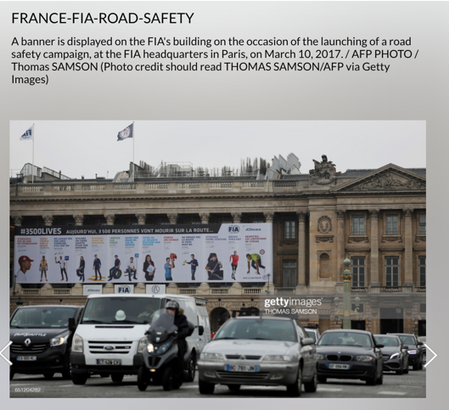
This text is a photo of a billboard that was displayed on the facade of the FIA Headquarters at the Place de la Concorde in Paris, from the 10th to the 13th of March 2017 (Thomas 2017). The billboard measured 28m by 7.8m and shows the ambassadors demonstrating the ‘Golden Rules’ of road safety (JCDecaux 2017). The point of the billboard is to draw the attention of the public by using the shocking statistic of 3,500 lives and the endorsement of its famous ambassadors, including the mayor of Paris Anne Hidalgo. The billboard is effective because it is displayed in a very popular area of Paris among the tourist sites in the 8th arrondissement. The billboard is also a great way of showing the variety of ambassadors involved in the project, including athletes, actors, musicians, and politicians, and uses bright colours and a large font for the main message and hashtag. However, this aspect of the campaign is limited in that it was only displayed for three days. Furthermore, the images are the same as those posted to the FIA’s social media channels and website, and are therefore not very dynamic, not to mention the fact that the text is so small that ironically it may be a distraction for drivers.Social Media Post – Appendix Three
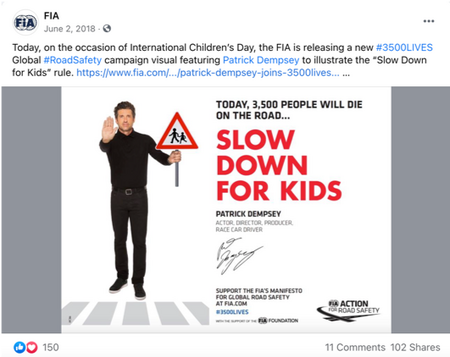
The final component of the campaign is a post from the FIA’s Facebook page made to coincide with International Children’s Day, announcing the new rule: slow down for kids. The image shows actor Patrick Dempsey holding a ‘slow down’ sign and features the same message as the images used for the billboard: “Today, 3500 people will die on the road … support the FIA’s manifesto for global road safety”. Unlike other aspects of the campaign, this text directly appeals to the viewer’s empathy and emotion by encouraging them to ‘think of the children’. It’s also successful in that the FIA has made use of its relatively large following on Facebook (over 500,000 ‘likes’ and followers) to reach a large audience, who are most likely parents. Furthermore, the post features an ambassador who is well-known and has a genuine interest in the issue, with Dempsey himself having young children. However, the post is limited again because the image is not very dynamic, therefore engagement with the post is very low with only 150 likes and 11 comments. When it comes to the campaign’s presence on social media, there doesn’t seem to be much engagement with the posts or hashtag, with either the same posters or photos of billboards being posted between other activities involving the FIA, with no dedicated space for #3500Lives.Discussion
Overall, these texts make up a campaign that appears very polished, with a clear and consistent message throughout. However it falls flat due to the lacklustre visuals, a missed opportunity considering the scope of the campaign in terms of its physical advertising as well as the online presence of the FIA and the ambassadors involved. Furthermore, whilst it’s good that the messaging is kept consistent across platforms, the campaign uses the same images across their physical advertising and posts on social media, so it appears that the material hasn’t been properly optimised for performance for individual channels. The one text that stands out is the YouTube video, as videos are often successful due to their “influential appeals and storytelling power” (Das et. al 2020), however it would’ve been even more so if it was posted on other social media channels in addition to YouTube.Nevertheless, the messaging of the campaign is strong in two ways: the use of statistics and the promotion of positive social norms. These strategies are what Guttman calls the appeal to reason and the appeal to social values (2016), meaning that the use of statistics (3,500 lives lost daily) shows the magnitude of the problem, and the use of ambassadors to encourage the adoption of safer behaviours reinforces the idea of collective social responsibility.However, that isn’t to say that the inclusion of celebrity ambassadors is not without its issues, especially regarding a global campaign such as this, as they have to be well-known, credible, and attractive for the endorsement to be effective (Chan et al. 2019). Furthermore, Brace-Govan suggests that ambassadors should be seen as positive role models, that can “engage the audience through personal relevance, attainability, and value reflection” (2013). This is where #3500Lives has its limits. For example, someone like Nico Rosberg, who represents the “Never Drink and Drive” rule, might be popular in Monaco, but perhaps not in countries where Formula One viewership is low, therefore making his endorsement less effective. This shows that the creators of the campaign have perhaps taken an ethnocentric approach – meaning they have taken a ‘one size fits all’ attitude when launching the campaign worldwide (Curtin and Gaither, 2007).Evaluation and Recommendations
#3500Lives is a very ambitious campaign, with the FIA attempting to appeal to the largest audience possible. Whilst this is impressive, it means that the campaign is limited as it doesn’t have a specific target audience. For example, the FIA references the WHO’s report that young people are the demographic most likely to die in a road accident yet haven’t done anything to make the campaign particularly appealing to them. One way they could do this is through the additional use of social media channels such as TikTok, or with ambassadors that are more popular among this demographic.However, that has its challenges: as the campaign is global, it can be difficult to select ambassadors that can appeal to a worldwide audience. My second suggestion is that ambassadors are selected based on their popularity and name recognition within certain countries. I would also recommend that the ambassadors have a more involved role with the campaign, as opposed to the ‘one and done’ photoshoot and social media approach that seems to be in operation now, as a sustained public commitment to the cause would help their credibility and therefore the effectiveness of their endorsement.As the campaign is so broad, it can be difficult to determine whether it has been successful in encouraging its audience to alter their attitude and adopt safe behaviour, though it seems unlikely. At first glance, it appears to be very impressive, especially due to the wide range of celebrities that have endorsed its message. However, after a closer analysis it appears that the campaign is unfocused and unspecific and is perhaps operating on too large a scale to be effective in having a lasting change on the behaviours and attitudes of the public.
.
Appendices
Text One: https://www.youtube.com/watch?v=xry-0rBMnB0Text Two: https://www.gettyimages.com.au/detail/news-photo/banner-is-displayed-on-the-fias-building-on-the-occasion-of-news-photo/651204006?adppopup=true
Text Three: https://www.facebook.com/fia/posts/1897815593582393
References
Adamos, Giannis, Eftihia Nathanail, and Paraskevi Kapetanopoulou. 2012. "Does the Theme of a Road Safety Communication Campaign Affect its Success?" Transport and Telecommunication 13 (4): 294.
http://dx.doi.org.libproxy.murdoch.edu.au/10.2478/v10244-012-0025-5.Brace-Govan, Jan. 2013. More diversity than celebrity: A typology of role model interaction. Journal of Social Marketing, 3(2), 111–126. https://doi.org/10.1108%2FJSOCM-05-2012-0079Castillo-Manzano, José I., Mercedes Castro-Nuño, and Diego J. Pedregal. 2012. “How many lives can bloody and shocking road safety advertising save? The case of Spain.” Transportation Research Part F: Traffic Psychology and Behaviour 15 (2): 174-187. https://doi.org/10.1016/j.trf.2011.12.008.Chan, Kara, and Ting Zhang. 2019. “An exploratory study on perception of celebrity endorsement in public services advertising.” International Review on Public and Nonprofit Marketing 16: 195–209. https://doi.org/10.1007/s12208-019-00225-3Curtin, Patricia, and Thomas Gaither. 2007. “Chapter Six: Practicing public relations in a global environment” in International public relations: negotiating culture, identity, and power. Thousand Oaks: SAGE Publications, Inc. https://doi.org/10.4135/9781452224817.n6Das, Subasish, Anandi Dutta, Abhisek Mudgal, and Songjukta Datta. 2020. “Non-fear-Based Road Safety Campaign as a Community Service: Contexts from Social Media.” In International Conference on Innovations for Community Services, pp. 83-99. Springer, Cham, 2020.FIA. “Mick Schumacher and Julian Alaphilippe - #3500LIVES.” YouTube video, 1:09. April 16, 2021. https://www.youtube.com/watch?v=xry-0rBMnB0.FIA. “The FIA and JCDecaux are renewing the #3500Lives global road safety campaign for the third year running.” November 21, 2018. https://www.fia.com/news/fia-and-jcdecaux-are-renewing-3500lives-global-road-safety-campaign-third-year-runningGuttman, Nurit. 2016. "Reprint of “Persuasive Appeals in Road Safety Communication Campaigns: Theoretical Frameworks and Practical Implications from the Analysis of a Decade of Road Safety Campaign Materials”." Accident Analysis and Prevention 97: 298-308.JCDecaux. “The Fédération Internationale de l’Automobile and JCDecaux launch the first worldwide outdoor campaign on road safety.” March 10, 2017. https://www.jcdecaux.com/press-releases/federation-internationale-de-lautomobile-and-jcdecaux-launch-first-worldwide-outdoorKollmuss, Anja and Julian Agyeman. 2002. "Mind the Gap: Why do People Act Environmentally and what are the Barriers to Pro-Environmental Behavior?" Environmental Education Research 8 (3): 239-260.Pauliukonytė, Ieva. 2019. “Eismo saugumo socialinio projekto “3500 lives” semiotinė analizė.” Master’s thesis, Vytautas Magnus University, 2019. https://vdu.lt/cris/handle/20.500.12259/60472Samson, Thomas. “A banner is displayed on the FIA's building on the occasion of the launching of a road safety campaign, at the FIA headquarters in Paris, on March 10, 2017.” www.gettyimages.com, AFP Collection, Editorial # 651204006, Getty Images, 2017, https://www.gettyimages.com.au/detail/news-photo/banner-is-displayed-on-the-fias-building-on-the-occasion-of-news-photo/651204006?adppopup=true.World Health Organisation. Global status report on road safety 2018. Geneva: World Health Organisation, 2018. Accessed August 18, 2021. https://www.who.int/publications/i/item/9789241565684
The following is a 10 Point Communication Campaign Plan that I was tasked with developing under exam conditions for COM345: Issue and Crisis Management. Our brief was to select a local government area and develop a campaign that informed residents of an incoming ban on wood heaters.
Background
The use of wood heaters is a major cause of poor air quality, creating damaging effects on the environment in the form of pollution and on the health of the population. According to the ABC (Branley and Scott 2021), only 10% of Australian households use wood heaters as their main source of heat during winter, but smoke from these heaters is the dominant form of man-made pollution in New South Wales, Victoria, the ACT, and parts of South Australia and Tasmania. According to Professor Fay Johnston, wood smoke is a particularly damaging form of air pollution as it is the result of ‘incomplete combustion'. Unlike other forms of smoke, the kind created by wood heaters consists of co-pollutants such as ozone, aldehydes, and polycyclic aromatic hydrocarbons, which are detrimental to the environment and human health.Furthermore, according to Dr John Blakey, a respiratory physician at Sir Charles Gairdner Hospital, particulates that are emitted from fires in wood heaters are small enough that they can enter the bloodstream and lungs, causing complications such as lung and esophageal cancer and increasing the risk of heart attack or stroke. Smoke from wood heaters is also incredibly dangerous to those who suffer from respiratory issues such as asthma, which affects roughly 1 in 9 Australians. Therefore, Asthma Australia is calling for the phasing out of wood heaters, with CEO Michele Goldman saying that their helpline is inundated with calls regarding attacks caused by smoke from these heaters. According to the aforementioned article from the ABC, the City of Wanneroo received 54 complaints regarding smoke from wood heaters in 2019 and 2020. For these reasons, the City of Wanneroo has decided to introduce a ban on the use of wood heaters that will come into effect on September 1, 2022.Problem and Opportunity
The current communication problem facing the City of Wanneroo is a lack of awareness and consideration surrounding the adverse effects of wood heaters. Research from Kollmuss and Agyeman (2002, 240) has found that there is a gap between the “possession of human environmental knowledge and … displaying pro-environmental behaviour”, simply meaning that if people are not aware of the damage that wood heaters cause to the environment, they will continue acting in a way that is damaging to the environment. Furthermore, even if people are made aware of the negative effects of wood heaters they may continue using them, a phenomenon explained by Kollmuss and Agyeman: “we might be perfectly willing to change our behaviour but still not do so, because we do not persist enough in practising the new behaviour” (256), in this case the new behaviour is limiting the use of wood heaters. What’s more, people may also be hesitant to adopt pro-environmental behaviours due to perceived difficulty or financial loss.For this reason, the City of Wanneroo is in need of a communication campaign that convinces its audience that changing their behaviour to be more pro-environmental is in the best interest of the environment and their own health. Therefore, I believe that an effective campaign should focus on educating its audience on the adverse effects that wood heaters have on the environment and public health whilst also persuading them that the incoming ban is both inevitable and in their best interest.Aims and Goals
The primary aim of this campaign is to raise awareness of the dangers of wood heaters to the environment and public health among residents of the City of Wanneroo. The goal of the campaign is to have implemented a communication campaign – called ‘Save Our Skies’ – which effectively convinces the target audience to adhere to the incoming ban by September 1, 2022.SMART Objectives
⠀⠀⠀⠀⠀⠀⠀- To see a decrease of 40% in air pollution caused by smoke from wood heaters in the City of Wanneroo when comparing data from the Winter of 2022 to the Winter of 2023
⠀⠀⠀⠀⠀⠀⠀- To see a decrease of 30% in hospital admissions for respiratory issues caused by smoke from wood heaters in the City of Wanneroo when comparing data from the Winter of 2022 to the Winter of 2023
⠀⠀⠀⠀⠀⠀⠀- To have received ‘pledges’ from 75% of homeowners with wood heaters in the City of Wanneroo to have their heaters removed by the end of 2022Target Publics and Stakeholders
The primary target public for this campaign is residents of the City of Wanneroo who have wood heaters in their homes. The City of Wanneroo is located north of Perth and stretches from Girraween in the south to Two Rocks in the north, and includes residential suburbs, industrial areas, areas of the Perth coastline and a largely rural area to the north and east. As of 2016, the population was 188,212 people with a median age of 33, living in 70,324 private dwellings (Australian Bureau of Statistics 2016). However, further preliminary research should be undertaken prior to the campaign as there is currently no data regarding how many of these homes have a wood heater. A secondary target public could be residents of areas in proximity to the City of Wanneroo who also have wood heaters in their homes, and who might spend time in areas where the campaign is conducted, such as shopping centres or their workplaces.The relevant stakeholders for this campaign include but are not limited to:
- City of Wanneroo Residents, especially:
⠀⠀⠀⠀⠀⠀⠀- Homeowners with wood heaters
⠀⠀⠀⠀⠀⠀⠀- People who suffer from respiratory issues such as asthma
- Local Government
⠀⠀⠀⠀⠀⠀⠀- Mayor: Brett Treby (Acting)
⠀⠀⠀⠀⠀⠀⠀- Councillors: Linda Aitken, Chris Baker, Helen Berry, Sonet Coetzee, Frank Cvitan, Natalie Herridge, Jacqueline Huntley, Paul Miles, Vinh Nguyen, Glynis Parker, James Rowe, Natalie Sangalli, and Jordan Wright
- State Government
⠀⠀⠀⠀⠀⠀⠀- Members: Sabine Winton (Wanneroo), Mark Folkard (Burns Beach), John Quigley (Butler), Margaret Quirk (Landsdale), Meredith Hammat (Mirrabooka), and Rita Saffioti (West Swan)
⠀⠀⠀⠀⠀⠀⠀- Ministers: Amber-Jade Sanderson (Health), John Carey (Housing; Lands; Local Government), and Reece Whitby (Environment)
- Media
⠀⠀⠀⠀⠀⠀⠀- Local: City of Wanneroo newsletter, PerthNow Wanneroo, and Joondalup/Wanneroo Times Community Newspaper
⠀⠀⠀⠀⠀⠀⠀- State: The West Australian, local TV news (10 News Perth), etc.
⠀⠀⠀⠀⠀⠀⠀- National: ABC News
- Asthma Australia
⠀⠀⠀⠀⠀⠀⠀- CEO: Michele GoldmanKey Message
The key message of the campaign is that wood heaters are actually quite dangerous to both the environment and the health of users and their neighbours and that the benefits of using such a heater do not outweigh these negative consequences. The slogan for this campaign is: Save Our Skies – Let’s do our part to protect our environment and ourselves. This inclusive language will hopefully create a sense of camaraderie and obligation among the target public.The messaging of this campaign will call on residents of homes with wood heaters to consider the negative impacts and act in the best interest of themselves and their fellow City of Wanneroo residents by finding alternative ways of heating their homes. The campaign will include messages regarding the many detrimental effects that the use of wood heaters can have, both on the environment and the body. Overall, the message will be educational and encouraging but still firm, so that the target public is made aware that the decision made by the City to disallow the use of wood heaters is the right one due to their negative effects.Strategy
The City of Wanneroo is in need of a communication campaign targeted at residents of the City that raises awareness of the upcoming ban on wood heaters on September 1, 2022, with the intent of educating them on the detrimental effects that these heaters have on the environment and on public health. The campaign will convey this message through the use of interpersonal channels (council meetings and a door-knocking campaign), traditional channels (flyers, pamphlets and posters), and online channels (informative website and social media posts). Research will need to be undertaken prior to the campaign in order to identify how prevalent the use of wood heaters is in the City of Wanneroo, data on the amount of air pollution these heaters generate, and the number of complaints and hospitalisations regarding the resulting smoke. The campaign will run from June to September 2022 ahead of the ban set to be implemented on September 1, 2022. The evaluation phase of the campaign will take place around September 2023 in order to compare data with that from the Winter of the previous year and properly evaluate the effectiveness of the campaign.Channels and Tactics
Interpersonal channels have been chosen as the primary means of communication because the City of Wanneroo is seeking to change the behaviours of the target publics, which they are more likely to do if they feel that the City is taking an active role in reaching out to residents. Furthermore, interpersonal channels are seen as the most persuasive and engaging of all channels. The tactics for this aspect of the campaign are:
⠀⠀⠀⠀⠀⠀⠀- Events: council meetings, environmental workshops, public forums, etc.
⠀⠀⠀⠀⠀⠀⠀- Information Exchange: door-knocking and community consultation (focus groups, etc.)Traditional channels should also be utilised in order to reach the majority of the target public. The tactics used will include:
⠀⠀⠀⠀⠀⠀⠀- Print Media: advertisements and articles in community newspapers
⠀⠀⠀⠀⠀⠀⠀- Physical Materials: pamphlets mailed to residents, posters in high-traffic areas such as schools, shopping centres and community facilities like libraries, and flyers handed out at community eventsThese channels should also be supported by online media channels such as an informative website where residents can ‘pledge’ to stop using their wood heater and posts on the City of Wanneroo website and existing social media pages. Due to restraints on resources it wouldn’t be productive to launch new social media accounts dedicated to the campaign, instead the City should make use of their existing accounts and should consider paying for advertised posts on platforms such as Instagram and Facebook.Evaluation
During the campaign, data should be continually monitored in order to evaluate the reach of the campaign. This will primarily include awareness surveys (e.g. questioning residents if they have seen the campaign materials to evaluate memorability), the analysis of social media engagement statistics (provided by Facebook and Instagram Insights), and web analytics (website visits). This would also include the number of residents attending events, the number of pledges on the website, and feedback from residents at community consultation sessions. However, as the ban is set to be implemented on September 1, 2022, this does not give the City much time to conduct any meaningful community consultation regarding the campaign and make necessary adjustments (usually based on measuring engagement and the analysis of qualitative research), so the City should be prepared for the possibility of criticism and backlash.Towards the end of the campaign, its success will be evaluated by comparing the data collected in 2022 regarding the number of homes with wood heaters, the number of complaints regarding smoke, the number of hospitalisations due to respiratory issues and the level of air pollution to the data collected over the Winter of 2023.Conclusion
The use of wood heaters causes detrimental effects on both the environment and the health of the general public, though most people are not aware of this. Therefore, the City of Wanneroo must implement a communication campaign that seeks to raise awareness of these negative effects ahead of the introduction of a ban on wood heaters. The ban will be implemented on September 1, 2022, and will utilise several interpersonal, traditional and online communication channels to convey the message that this ban is in the best interest of the general public.Discussion
Personally, I believe that the parameters of this campaign won’t allow it to live up to its full potential. I believe it would be a lot more effective if it were to take place over a longer period of time, perhaps starting in the early Autumn of 2023 to be effective over next Winter. It is also incredibly important that community consultation take place in any kind of decision made by a local government, but this wouldn’t be possible with this kind of project. Furthermore, a flat-out ban on wood heaters fails to consider that they are one of the least expensive ways of heating a home and are often used by those in regional or low socio-economic areas. For this reason, I think that the introduction of a buy-back scheme would be a more effective way of limiting the use of wood heaters, especially if it were in partnership with the state government, as people are unlikely to adapt their behaviour without some kind of incentive.I believe that the issue identified in this campaign, the banning of wood heaters due to their detrimental effects on the environment and health, would sit more towards the ‘Inform’ end of the IAP2 Spectrum of Public Participation. This means that the decision has been made by the City of Wanneroo and that they will simply provide the public with ongoing information regarding the ban and provide materials that help them understand why it is necessary. Personally, I believe that a campaign regarding this topic would be more effective if it were to include aspects of consultation and involvement from the target public, in order to make them feel like they have some kind of say on the issue. Nevertheless, I am hopeful that once the target public is made aware of the detrimental effects that wood heaters can have on the environment and on people’s health those who are able would willingly alter their behaviour and stop using their wood heaters, therefore adopting a pro-environmental behaviour.
.
References (Chicago Style)Archer, Catherine. 2019. Issues Management Community Consultation and Engagement. Podcast Lecture. In Issues and Crisis Management (COM345). Lecture recorded at Murdoch University in 2019, 16 min. https://echo360.net.au/lesson/7d85121e-7bb3-466c-87ce-0aba2e3fc755/classroom#sortDirection=descAustralian Bureau of Statistics. 2016. “Wanneroo 2016 Census QuickStats.” Accessed June 21, 2022. https://www.abs.gov.au/census/find-census-data/quickstats/2016/LGA58760Branley, Alison and Sophie Scott. 2021. “Call to phase out wood heaters due to health, environmental concerns – but minister says move not supported by community.” ABC News. June 18, 2021. https://www.abc.net.au/news/2021-06-18/call-to-phase-out-wood-heaters-due-to-health-concerns/100202388Dietsch, Jake. 2022. “Indiana Teahouse survey: Support floods in for major revamp of Cottesloe’s ‘postcard attraction’.” PerthNow. April 21, 2022. https://www.perthnow.com.au/local-news/perthnow-western-suburbs/indiana-teahouse-survey-results-reveal-support-for-change-c-6485008Jaques, Tony. 2014. “Crisis Management – Disasters.” In Issue and Crisis Management: Exploring Issues, Crises, Risk and Reputation. 203 – 233. South Melbourne, Victoria: Oxford University Press. https://ebookcentral.proquest.com/lib/murdoch/detail.action?docID=4786469.Kollmuss, Anja and Julian Agyeman. 2002. "Mind the Gap: Why do People Act Environmentally and what are the Barriers to Pro-Environmental Behavior?" Environmental Education Research 8 (3): 239-260. https://doi.org/10.1080/13504620220145401Shahi, Gautam Kishore, Anne Dirkson, and Tim A. Majchrzak. 2021. "An Exploratory Study of COVID-19 Misinformation on Twitter." Online Social Networks and Media 22: 100104-100104. https://doi.org/10.1016/j.osnem.2020.100104Smith, Brian G., Staci B. Smith, and Devin Knighton. 2018. "Social Media Dialogues in a Crisis: A Mixed-Methods Approach to Identifying Publics on Social Media." Public Relations Review 44 (4): 562-573. https://doi.org/10.1016/j.pubrev.2018.07.005
This is an exploration of the topic of community consultation in relation to an ongoing issue in the Perth community for COM345: Issue and Crisis Management. My chosen topic was the controversial redevelopment of the Indiana Teahouse.
Community Consultation and Developments/Projects
The key proponents of the Indiana Teahouse redevelopment project are Andrew and Nicola Forrest, who are working through their investment company Tattarang (formerly the Minderoo Group) and its property division Fiveight. The land lease is held by Perth Venues Pty Ltd, another organisation controlled by the Forrests. They are the most prominent people who are for the development and live in the Cottesloe area. There haven’t been any prominent people who have stated their opposition to the project, but there have been some local residents who are against the redevelopment, such as former Town of Cottesloe council candidate Sandra Boulter who ran on a platform relating to the preservation of the building but was unsuccessful.Stakeholders
The Indiana Teahouse redevelopment project is located on the Cottesloe foreshore within the Town of Cottesloe in Perth’s western suburbs. The current Mayor is Lorraine Young and the Councillors are Helen Sadler, Caroline Harben, Chilla Bulbeck, Paul MacFarlane, Melissa Harkins, Craig Masarei, Kirsty Barrett, and Brad Wylynko.As of the 19th of May 2022, the Federal Member of Parliament for the electorate of Curtin is Celia Hammond of the Liberal Party and the State Member of Parliament for the electorate of Cottesloe is Dr David Honey also of the Liberal Party. The State Government Ministers and their departments who may be affected by or involved in decisions regarding this development include:
⠀⠀⠀⠀⠀⠀⠀- Roger Cook (Minister for State Development, Jobs and Trade; Tourism; Commerce; Science)
⠀⠀⠀⠀⠀⠀⠀- David Templeman (Minister for Culture and the Arts; Sport and Recreation; International Education; Heritage)
⠀⠀⠀⠀⠀⠀⠀- Rita Saffioti (Minister for Transport; Planning; Ports), John Carey (Minister for Housing; Lands; Homelessness; Local Government)
⠀⠀⠀⠀⠀⠀⠀- Reece Whitby (Minister for Environment; Climate Action)The Federal Government Ministers who may have an interest in this development include:
⠀⠀⠀⠀⠀⠀⠀- Paul Fletcher (Minister for Communications, Urban Infrastructure, Cities and the Arts)
⠀⠀⠀⠀⠀⠀⠀- Dan Tehan (Minister for Trade, Tourism and Investment)The following are three articles relating to the Indiana Teahouse redevelopment project:
⠀⠀⠀⠀⠀⠀⠀- “Cottesloe Beach Indiana tearooms redevelopment leaves community divided as City Beach thrives” from the ABC
⠀⠀⠀⠀⠀⠀⠀⠀⠀⠀⠀⠀⠀⠀-https://www.abc.net.au/news/2019-09-19/cottesloe-beach-redesign-options-to-decide-fate-of-indiana/11525478
⠀⠀⠀⠀⠀⠀⠀- “Indiana Teahouse survey: Support floods in for major revamp of Cottesloe’s ‘postcard attraction” from PerthNow
⠀⠀⠀⠀⠀⠀⠀⠀⠀⠀⠀⠀⠀⠀- https://www.perthnow.com.au/local-news/perthnow-western-suburbs/indiana-teahouse-survey-results-reveal-support-for-change-c-6485008
⠀⠀⠀⠀⠀⠀⠀- “Andrew Forrest’s Indiana Teahouse Project Dodges Dismissal” from The Urban Developer
⠀⠀⠀⠀⠀⠀⠀⠀⠀⠀⠀⠀⠀⠀- https://www.theurbandeveloper.com/articles/andrew-forrest-s-indiana-teahouse-project-dodges-dismissalMedia organisations and journalists who have shown an interest in the development include:
⠀⠀⠀⠀⠀⠀⠀- the ABC (Benjamin Gubana, Evan Morgan Grahame, and Emily Piesse)
⠀⠀⠀⠀⠀⠀⠀- PerthNow (Jake Dietsch, Kim Macdonald, Bethany Hiatt, and Nadia Budihardjo)
⠀⠀⠀⠀⠀⠀⠀- The Urban Developer (Marisa Wikramanayake and Alexandra Cain)
⠀⠀⠀⠀⠀⠀⠀- WA Today (Peter de Kruijff, Sarah Brookes, Heather McNeill, and Daile Cross).There are currently no Facebook groups, blogs, or forums related to the development. However there is a website, Instagram account and Facebook page operated by Fiveight that provides information about the development, benefits to the community, the history of the Indiana Teahouse, and upcoming events and other news. It can be found here: https://www.indiana.com.au/. Many of the stakeholders can be found on Twitter, particularly those involved in State and Federal Government, though there doesn’t appear to be any Twitter accounts for the Local Government Councillors.Messages
The key message related to the redevelopment is that it will be of great benefit to the community whilst simultaneously retaining and enhancing the heritage-listed site. The developers propose keeping the existing Western facade intact but constructing a larger structure on the Eastern side that would feature a boutique hotel and subterranean day spa. The existing building would feature new public facilities, boat storage and food kiosks for beachgoers on the ground floor, a terrace with a casual restaurant and alfresco space, and a level on Marine Parade featuring a fine dining restaurant and café. The developers maintain that these developments will have a positive effect on the community by upgrading existing facilities, increasing tourism and business in the local area, and the retention and protection of a heritage WA building in the form of the Western façade.Originally the main concern regarding the development was the destruction of the ‘iconic’ façade, which would have taken place if some of the original plans had gone ahead. However, now that Tattarang/Fiveight have settled on a redesign that features the façade, the criticism has shifted to environmental concerns regarding the Norfolk Island Pine trees that are protected by the Cottesloe Beach precinct heritage listing. As the article mentions, the developers are currently at a bit of a standstill with the Town of Cottesloe regarding the assessment of Tattarang’s report claiming their project is in line with the council’s conservation management plan for the area. The Town says they don’t have the resources to verify this so are requesting that Tattarang pay for an independent expert and give them adequate time to assess their findings. Furthermore, there doesn’t appear to be much vocal opposition to the redevelopment from any organised groups, and a majority of residents in the Town of Cottesloe appear to be supportive of it, though this may change as the project continues.Tactics
Tattarang/Fiveight are using a number of tactics to grow support for the development, particularly using traditional and online media channels. They have launched a Facebook page, Instagram account and website for ‘Indiana Perth’ that seek to promote the development whilst also subtly challenging the misconception that it would be destructive to a ‘historical’ landmark when in fact the current building was constructed in 1996. There have also been a large number of articles talking about the widespread support for the project posted on news website PerthNow, so they are obviously effectively reaching out to relevant local media organisations to promote the development. On the other hand, as there hasn’t been any organised opposition to the development from the community there are no tactics to analyse at this time.
This is a communication campaign plan created for COM214: Strategy and Planning. The client was the Department of Agriculture, Water and the Environment and the brief was to raise awareness of plastic-free living and reducing plastic-waste generation among key stakeholders and publics.
Background
The production and generation of plastic waste poses a serious threat to both the environment and human health, and therefore to the future of our planet. Annually, Australia produces 2.5 million tonnes of plastic waste, including 1 million tonnes of single-use plastics such as bottles, straws, and cutlery (Wahlquist 2021). It is imperative that the Department of Agriculture, Water and the Environment (DAWE) develops a plan to limit the production and the generation of plastic waste. The main way that this can be achieved is by limiting the amount of plastic waste generated by stakeholders and publics, as well as by educating them on the benefits of plastic-free living. This is a phenomenon that has been growing in popularity since the 1980s and is more commonly known as the modern zero-waste movement. If we are to work towards a zero-waste society, we have to be willing to “appreciate the sustainable way that our ancestors lived” and “take those lessons and use them to improve and inform our future” (Krosofsky 2021).Therein lies the issue with communicating the need to adopt plastic-free living practices: Kollmuss and Agyeman (2002, p240) found that there is a “gap between the possession of human environmental knowledge and environmental awareness and displaying pro-environmental behaviour”. Furthermore, even if audiences are aware of the dangers that single-use plastics pose to the environment, they may continue to use them, with Kollmuss and Agyeman explaining that “we might be perfectly willing to change our behaviour but still not do so, because we do not persist enough in practising the new behaviour until it has become a habit” (p256). For these reasons, the DAWE is in need of a strategic communication plan that is able to convince its audience to alter their behaviour and adopt pro-environmental behaviours. Therefore, I believe the most effective campaign would focus on the education of younger generations on the need to be considerate of the impact that individuals can have on the environment. When preparing this campaign, further research should be undertaken into similar communication campaigns that have been implemented in schools, as well as other environmental education campaigns.Currently, the DAWE does not have any educational campaigns targeting this demographic regarding plastic waste or plastic-free living. The main communication platform utilised by the DAWE is the environment.gov.au website, which mostly includes information on various environmental issues, resources for businesses, and online services such as permits. Some social media channels do exist (a Facebook page and Twitter and Instagram accounts), though the content is mostly reposted from other government departments and organisations and is not very engaging.SWOT Analysis
Strengths
- Site contains a lot of relevant information on the dangers of single-use plastics and detailed ways that people can reduce their plastic waste generation
- Strong call to action in the form of a ‘What you can do’ section
- ‘Plastics’ page is accessible and easy to navigate
Weaknesses
- Site is difficult to find, and lacking SEO
- Possible overload of information (especially with the timeline)
- Lack of integration with social media and other channels
Opportunities
- Collaboration with other government departments
- Ability for the department to collaborate with other platforms or social media channels with larger followings (@westernaustralia, @cityofperth, @waparkswildlife, etc.)
Threats
- Increased use of social media and digital platforms may limit engagement rates among older audiences
- Beauracracy associated with government organisations
- May be ineffective if unable to influence the audience to alter their behaviourProblems and Opportunities
The current communication problem faced by the DAWE is the lack of awareness of both the simplicity and necessity of plastic-free living. This is because they haven’t developed a communication campaign dedicated to education surrounding plastic waste and plastic-free living. Furthermore, adults that may typically be targeted in these sorts of campaigns may currently feel overwhelmed by other marketing or communication campaigns that they perceive to be more important, such as those regarding Covid-19 and vaccinations. They also could suffer from over-targeting, over-saturation and ad fatigue, which causes a drop in engagement. Therefore, I propose that the DAWE take this opportunity to develop a communication campaign in the form of an educational program for primary school children.Goals and Objectives
The primary aim of this campaign is to raise awareness among primary school-aged children of the necessity of plastic-free living and the need to reduce plastic waste generation. The goal of this campaign is to have implemented an educational communication program – called ‘Waste Less Week’ – that engages children and convinces them to consider the effect that they as individuals can have on the environment.SMART Objectives
- To have run a successful pilot program in two Year 4 classes at 20 Western Australian schools during Term One of 2022
- To have implemented a wider program in Years 1 to 6 at 100 Western Australian schools during Term Two of 2022, coinciding with Earth Day on the 22nd of April
- To have received 5,000 ‘pledges’ from students to take action to limit their use of single-use plastics and adopt plastic-free living practices via the ‘Waste Less Week’ interactive website by the end of April 2022
- To expand the ‘Waste Less Week’ social media platform to 5,000 followers on Instagram, 10,000 likes on Facebook and 2,500 followers on Twitter in the first half of 2022, with these numbers increasing by 25% in the second half of 2022Target Publics, Audiences and Stakeholders
According to Mahoney’s definition – “people with whom the organisation wants to establish a relationship and with whom it exchanges messages” (2016) – the primary target publics for this campaign are school students aged aged 6 to 13. It would be effective to target this age group as it not only works to educate the next generation and impart environmental values, but these children would also influence their families. Practitioners are beginning to develop an “awareness of children's power of persuasion on their parents' behaviour” and their “ability to convince and persuade their family environment”, which grows with age (Sramova 2015), so we could consider them the secondary target public.Therefore, both the students and their parents are also the recipients of the key messages. Others that could be considered recipients of the messages, though not directly targeted, could include teachers and education assistants, childcare workers, older siblings of the students, and members of the wider school community, as well as employees at the DAWE who are involved in the campaign or other aspects of the organisation.The main internal stakeholders for this campaign are employees at the DAWE and the Department of Education (though these could also be considered external, as they govern how programs such as these are to be implemented), who have the most vested interest in seeing this communication campaign be implemented. On the other hand, some external stakeholders include activists, charities dedicated to environmental issues, companies who produce plastic waste, local community members, and governments (local, state and federal, and consisting of public servants and politicians).Message
The main message of this campaign is that everyone can do their part, around their home and in the classroom, to reduce the amount of single-use plastic that they use and therefore the amount of plastic waste that they generate. Therefore, the slogan for the program, which would initially run for one week, would be titled ‘Waste Less Week’, to encourage students to try generating less plastic waste.The campaign would include messages regarding plastic-free alternatives to household items, the need to properly recycle, and the benefits of adopting a plastic-free lifestyle, and would also communicate some of the negative effects that plastics can have on the environment. Different topics would be discussed on each day of the week, such as ‘Microplastics Monday’ or ‘Waterways Wednesday’. Overall, the message should be hopeful and encouraging, so that students and their families feel that if they adopt some of these behaviours their actions will have a positive effect on the environment.Strategy
The DAWE is in need of an educational communication campaign targeted at primary school children that raises awareness of the necessity of plastic-free living and the need to reduce plastic waste generation, with the intent of encouraging them to consider how their individual use of plastics can impact the environment. The campaign will convey this message through interpersonal channels (presentations and activities), traditional channels (posters and flyers), and online channels (an updated website and social media accounts). Campaign materials will feature bright colours and eye-catching graphics and illustrations. Research will be undertaken prior to the campaign to identify any gaps in the student’s knowledge or the curriculum, so as to make sure that relevant information is being communicated properly. The campaign will run a pilot program in early 2022, where its effects will be evaluated and any alterations made, before launching in April 2022. A month after the programs run research will be conducted into the memorability and effectiveness of the campaign and its messages.Channels and Tactics
Interpersonal channels – “the most persuasive and engaging of all communication tactics” (Smith 2013) – have been selected as the primary means of communication as the DAWE is seeking to gain a high amount of personal involvement and engagement from students. The tactics for this element of the campaign include:
⠀⠀⠀⠀⠀⠀⠀- Information Exchange: running of in-class activities, presentations and performances at school assemblies, and show-and-tell featuring alternatives to products that generate plastic waste
⠀⠀⠀⠀⠀⠀⠀- Special Events: competitions to create sculptures or artwork that repurpose single-use plastics, events coinciding with Earth Day in April 2022 (e.g. wearing a green shirt to school, etc.)Digital media channels will also be utilised to support the main aspects of the campaign, to help members of the target publics that may be seeking further information as well as to further spread the messages of the campaign. The tactics used will include:
⠀⠀⠀⠀⠀⠀⠀- Web: the DAWE should create a specific website dedicated to the campaign, featuring interactive video games for kids, further information on plastic-free living in the form of feature articles, and extra resources for teachers, parents, and community members
⠀⠀⠀⠀⠀⠀⠀- Social Media: the DAWE should also create dedicated social media accounts, primarily on Instagram, Twitter and Facebook, in order to provide updates on the campaign, share content created by students and schools (photos of artwork, events, etc.), and should utilise opportunities for audience expansion by collaborating with other government social media accountsThese channels should also be supported by traditional means of communication in the form of posters, advertisements in community and school newsletters, and flyers that students can take home.Evaluation and Modification
Throughout the duration of the campaign, a number of elements should be monitored to evaluate the reach of the campaign. This mostly includes social media engagement statistics (provided by services such as Facebook and Instagram insights and Twitter analytics) and web analytics (visitors to the website, page views, etc.). It should also include attendance at events, the number of submissions to the contests and pledges received, and the number of players for the online interactive games.Running a pilot program early in the school year will allow the DAWE to identify any possible issues with the campaign and make any necessary adjustments by measuring engagement and conducting qualitative research (such as interviews with teachers and students) in order to gain a better understanding of the strengths and weaknesses of the program.At the conclusion of the campaign, its success will be evaluated by comparing the data collected to the initial goals of running the program in 100 schools and increasing social media and web engagement. Furthermore, a month after the conclusion of the campaign research will be undertaken in the form of surveys and questionnaires into the memorability of the campaign’s messages, and to see if the target publics have made any changes regarding the amount of single-use plastics they generate.Conclusion
Plastic waste generation and the use of single-use plastics pose a major threat to our environment. Therefore, it is necessary that the DAWE take this opportunity to collaborate with the Department of Education to create a communication campaign that seeks to raise awareness of this issue among school children. The ‘Waste Less Week’ program will be implemented in a number of schools throughout Western Australia during 2022 and will utilise a number of interpersonal and digital communication channels in order to convey the message that everyone can have an impact on the amount of plastic waste that is generated in Australia by using plastic-free options and adopting pro-environmental habits.